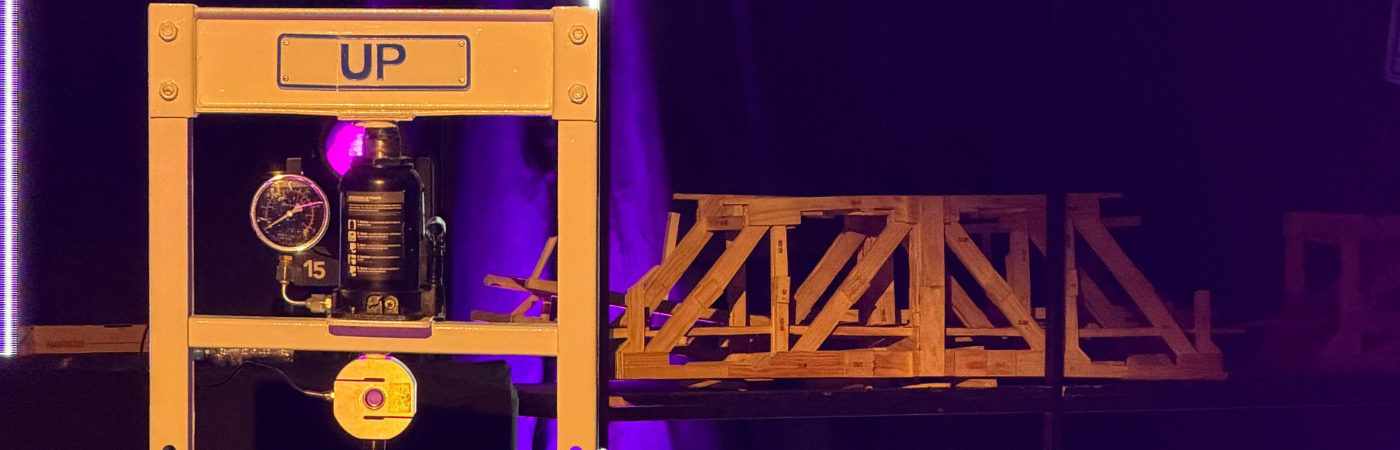
When we heard there would be a bridge resistance competition at the Open Doors event at Universidad Panamericana, we thought: “Okay, sounds easy, how hard can it be to build a wooden bridge?” (Spoiler: much harder than we imagined.)
Jorge Gómez Haro
“My favorite part was when we started planning the design. We had to consider a thousand factors! We researched the different strengths of the woods, the types of glues, and of course, how to achieve an efficient design. In the end, we decided to build a bridge with a Howe truss (a type of structure used in civil engineering). Later on, I realized it wasn’t just about sticking little pieces together—it was about making every decision count so the bridge could have the best resistance.
The biggest challenge for me was controlling precision. Sometimes a single millimeter made the difference between strong joints or a total disaster. Even so, when we saw the finished bridge, I felt enormous pride. And although our nerves were at their peak before the resistance test, the excitement of seeing how much it endured was incredible. In the end, all our two weeks of effort were completely worth it, since we won first place in structural efficiency.”
Ivanna Aguilar
“When we signed up for the competition, I thought: ‘Oh, this is going to be super easy, like building a Lego.’ But as we started having meetings with our coach and he explained all the calculations, my whole perspective changed. It was actually much more than just cutting and gluing pieces. He explained how to calculate the force each piece received and, with that, how to minimize its weight so it could handle the applied force and achieve the greatest efficiency.
At first, it was a bit difficult to understand, but by the time we finished the bridge, everything made perfect sense. As Gómez-Haro, one of my teammates, would say: ‘I don’t understand much right now, but that’s why I’m going to study civil engineering.’ Weeks went by and we already had the wood—now we just had to cut it and glue it. Cutting it was a whole challenge because we had never used a jigsaw before, and at the beginning our cuts came out super crooked. It was funny because Zepeda, another team member, would say: ‘A little sanding will fix it.’ Then came the moment to glue everything, and we glued it crooked too, which affected the resistance.
We dedicated 6 to 7 hours a day for two weeks straight, but in the end, the teamwork, the bonding, the dedication, the discipline, and the effort we put into the bridge were completely worth it and rewarded with first place in the resistance test. I’m grateful to my team for always being there for me and encouraging me.”
Jorge Zepeda
“Throughout the process, we faced several challenges that forced us to adapt, collaborate, and solve problems strategically. Each difficulty allowed us to identify our areas for improvement, strengthen our technical and communication skills, and understand the importance of planning ahead. Thanks to these challenges, we developed greater confidence, learned how to make decisions under pressure, and worked as a team to achieve a solid and well-founded result.”
“Beyond the prizes, the most valuable part was the learning experience, the moments we shared, and the satisfaction of proving that effort really pays off.”
After so many hours of work, late nights, stress, and last-minute adjustments, seeing the final result made everything worth it. Besides the structural efficiency contest, we also took a math knowledge exam and gave an oral presentation in front of judges. Our prior knowledge helped us a lot in the exam, and our public speaking classes allowed us to present in the best possible way. As a result, we earned first place, a 50% scholarship to study our degree at Universidad Panamericana, and an iPad for each team member. But beyond the prizes, the most valuable part was the learning, the shared experiences, and the satisfaction of proving that effort, consistency, and teamwork truly bear fruit.

Follow Us!


All rights reserved © 2024 | Privacy Notice