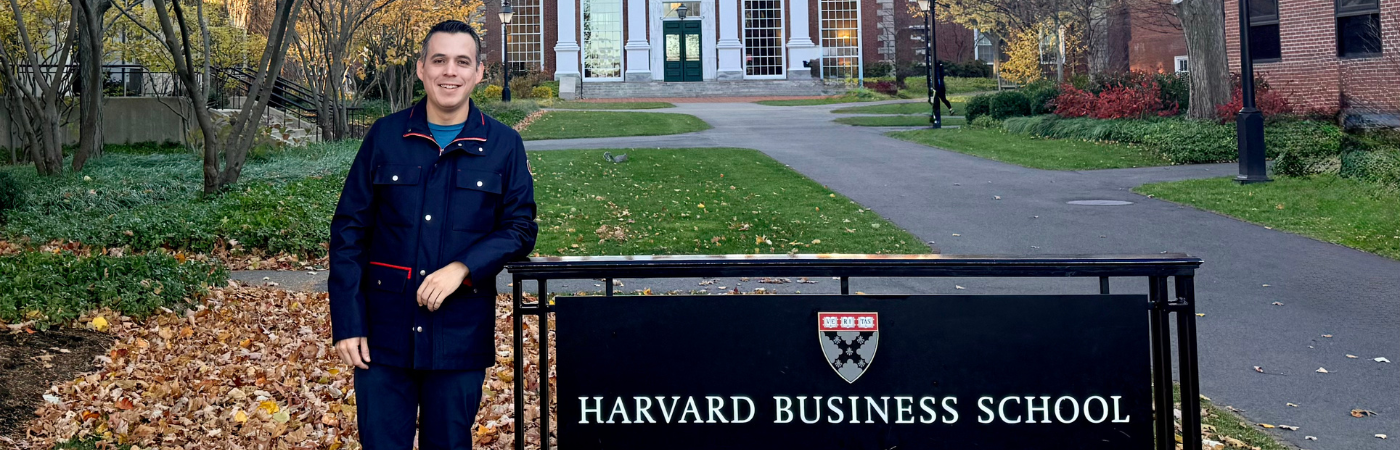
When I was a child, I dreamed of studying at Harvard. Not because of the name or the prestige, but because of the idea of learning from those who dedicate themselves to going further. That dream stayed remained in my mind for many years, until life led me down different paths. Returning there after 36 years to study Negotiation was deeply symbolic. Not as a personal achievement, but as a confirmation of something that drives my life: continuing to learn is a responsibility when we educate others.
Before the course, I would hold several assumptions that I now question. I thought negotiation was something activated only in big, tense, or “important” moments. I believed negotiating meant defending a position firmly, even harshly, and that emotion needed to stay out of it so it wouldn’t “get in the way.” And like many others, I assumed that negotiating well meant reaching a win-win agreement.
Today, I think differently.
The first thing I understood is that we negotiate all the time. We negotiate when we listen or interrupt. When we ask or assume. When we explain a decision or impose it. At home, at school, at work.
Negotiation is not a technique; it is a transversal life skill.
The second realization was understanding that what often causes conflict are not decisions themselves, but interpretations. Most friction does not stem from bad intentions, but from not knowing what the other person is trying to protect. When we stop fighting for “what I want” and begin listening to “why I need it,” the conversation changes.
I also learned that negotiating is neither giving in nor winning. It is about building agreements that can be sustained over time because they respect the people involved. In an educational community, this is especially important. We continue to coexist after difficult conversations. What breaks in the relationship cannot be fixed with a signed agreement.
But perhaps the most powerful lesson did not come from the classroom, but from something I confirmed when I returned home: my children are my best proof.
Everything I learned at Harvard, I practice first with them. When I am tired and want to impose. When I realize I did not fully listen. When I ask a question expecting one answer… and they give me another. That is when I remember that negotiating also means learning to see through the brain of the one who is learning.
There is an idea that has always stayed with me from Mtro. José Antonio Fernández, inspired by experiences with children and young people, and that today feels more relevant than ever. Once, an adult asked a child, “If you have three candies, can you eat five?” The child answered, “No, because I would throw up.” At first, the adult thought the child was not reasoning. Later, he understood something deeper: the child was reasoning, just from his own experience. He was not solving a math problem; he was protecting his body.
The same thing happens in negotiation and in education. When the response is not what we expected, we tend to correct the other person. Rarely do we stop to ask ourselves what logic lies behind what was said.
Children also teach us this: listening is not just hearing words; it is asking why they say what they say and why they do what they do.
At DiME, this learning becomes an institutional commitment. We aim to educate students with transversal life skills: knowing how to dialogue, manage disagreement, express what they feel without hurting others, uphold boundaries with respect, and build fair agreements. These skills are not taught through speeches; they are taught through daily practice and by adults who are also learning.
For this reason, learning negotiation was not about learning how to “win conversations.” It was about learning how to learn better, how to teach from the perspective of others, and recognizing that practice is the best teacher. And that, many times, those who teach us the most are not standing in front of a blackboard, but sitting at home, asking us unexpected questions.
Today, I return from Harvard with gratitude, humility, and the certainty that continuing to learn, listen, and adjust is part of educating. And of living.
Roberto O.

Follow Us!


All rights reserved © 2024 | Privacy Notice